(Screenshot: nature.com)
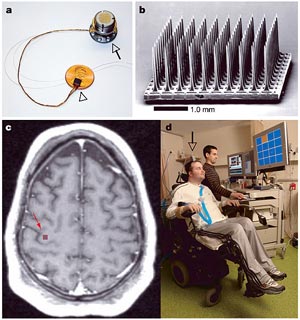
Das Magazin Nature hat in seiner Ausgabe 442 einen Aufsatz von mehreren Wissenschaftlern über den erfolgreichen Einsatz einer Hirn-Computer-Schnittstelle bei einem vom Hals abwärts gelähmten Patienten veröffentlicht. Dem Patienten wurde dazu ein Sensor in den Teil der Großhirnrinde eingesetzt, der für Bewegungen verantwortlich ist. Im Ergebnis ist der Patient in der Lage einen Cursor zu steuern, um Emails zu lesen oder einen Fernseher zu bedienen. Weiterhin konnte der Patient mit Hilfe des Systems einen Roboterarm öffnen und schliessen:
Neuromotor prostheses (NMPs) aim to replace or restore lost motor functions in paralysed humans by routeing movement-related signals from the brain, around damaged parts of the nervous system, to external effectors. To translate preclinical results from intact animals to a clinically useful NMP, movement signals must persist in cortex after spinal cord injury and be engaged by movement intent when sensory inputs and limb movement are long absent. Furthermore, NMPs would require that intention-driven neuronal activity be converted into a control signal that enables useful tasks. Here we show initial results for a tetraplegic human (MN) using a pilot NMP. Neuronal ensemble activity recorded through a 96-microelectrode array implanted in primary motor cortex demonstrated that intended hand motion modulates cortical spiking patterns three years after spinal cord injury. Decoders were created, providing a ‘neural cursor’ with which MN opened simulated e-mail and operated devices such as a television, even while conversing. Furthermore, MN used neural control to open and close a prosthetic hand, and perform rudimentary actions with a multi-jointed robotic arm. These early results suggest that NMPs based upon intracortical neuronal ensemble spiking activity could provide a valuable new neurotechnology to restore independence for humans with paralysis.
Siehe auch:
Neuronal ensemble control of prosthetic devices by a human with tetraplegia
